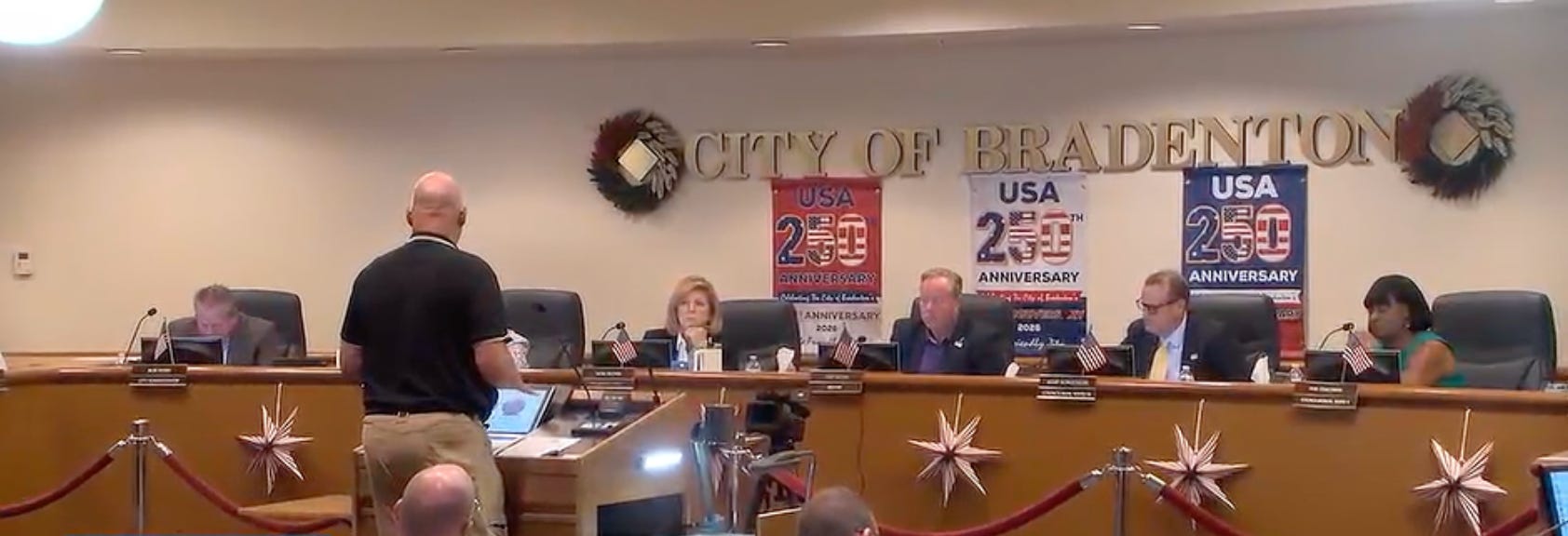
The Bradenton City Council has unanimously advanced a redevelopment proposal identifying 16 areas where city officials say conditions could warrant additional public and private investment.
The council, meeting with the Bradenton Community Redevelopment Agency, held a public hearing on Wednesday on a Finding of Necessity examining properties affected by conditions, including vacant or underused land, deteriorating improvements, fragmented ownership, outdated lot configurations and concentrations of government-owned property.
The effort builds on a 2023 study documenting slum and blight conditions within portions of the city. The findings are part of the process required for the city and CRA to pursue redevelopment strategies intended to address public health, safety and economic conditions.
Among the properties identified are several prominent downtown sites, including the former City Hall property at 500 15th St. W., the Montgomery Roberts property, the Bradenton Herald site at 313 12th St. W., the downtown library property at 1301 First Ave. W. and the City Center area.
The study also includes the Manatee County administration complex, the Herrig Center area, Players Center area, Third Avenue properties, the Courtyard Marriott/Riverfront property, a fire station block and the shuffleboard and Ballard Park area.
Outside the downtown core, the study identifies Tarpon Point along portions of Sixth Street East and the Manatee River, River Run Golf Links and the adjacent Jordan Creek development property, sites along Manatee Avenue East near 18th and 19th streets, and the historic Pelot’s Pharmacy property near Manatee Avenue East and Ninth Street East.
Conditions vary by property. Some locations contain deteriorating or obsolete improvements, while others have remained vacant or underdeveloped for decades. Several contain irregular parcels or multiple owners that can make redevelopment more difficult.
Government ownership is another issue highlighted in the findings. Six of the identified sites include property owned by the city or county. Because government property is generally tax-exempt, large concentrations of publicly owned land can limit the taxable value generated within a redevelopment district even when the properties themselves have substantial value.
CRA Executive Director Dr. Jeff Burton said the agency can serve as a connection between government and private investment as redevelopment opportunities are considered.
The former Montgomery Roberts property has remained vacant for decades, while the former City Hall property is another major downtown site officials hope can eventually return to productive use. City leaders said redeveloping underused properties could also place additional property on the tax rolls.
The study describes broader conditions that officials say interfere with development, including defective street and lot layouts, deterioration of site improvements, fragmented ownership and stagnant assessed values. City officials contend some of those conditions have persisted despite opportunities for private redevelopment.
Mayor Gene Brown emphasized the role of public hearings in allowing residents to learn about redevelopment plans and provide input as proposals move forward.
Wednesday’s unanimous action is an early step in a longer review process rather than approval of specific development projects.
The proposal will next go before the Bradenton Planning Commission for review of its consistency with the city’s comprehensive plan. It will then be forwarded to the Manatee County Commission, which will have up to 60 days to review the proposal and provide recommendations before it returns to the City Council.
Bradenton currently has three community redevelopment areas scheduled to expire in 2040. With about 14 years remaining, CRA officials say the city is looking at ways to address redevelopment needs while using CRA funding mechanisms intended to limit additional financial impacts on taxpayers outside the redevelopment areas.