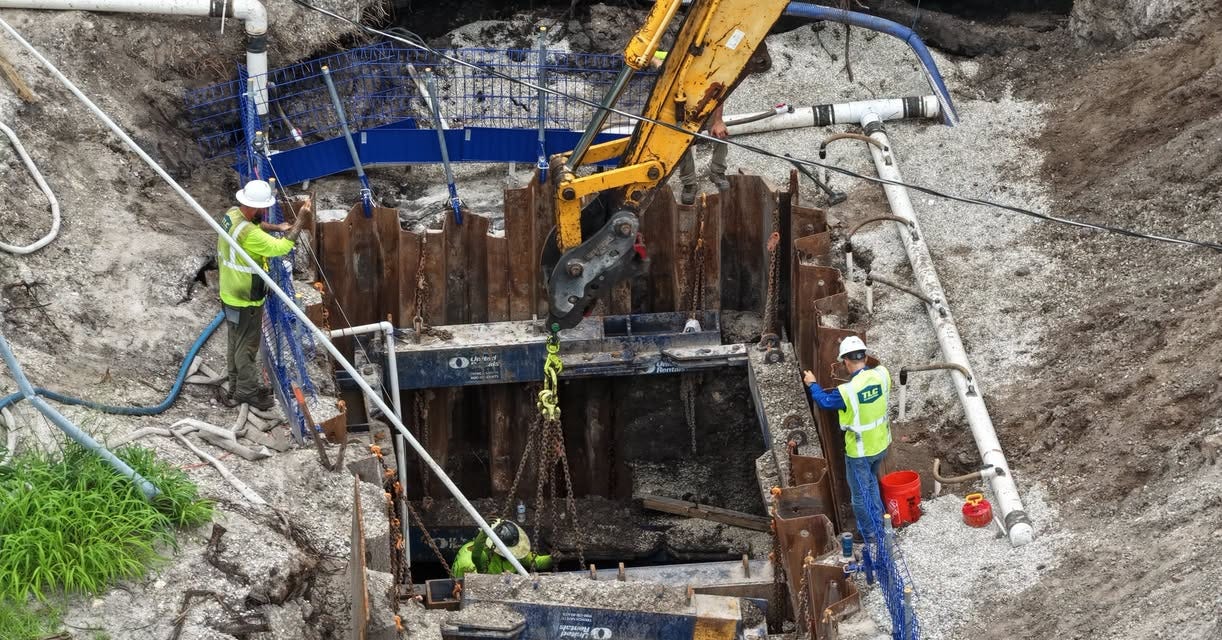
Work is continuing on the City of Bradenton’s Lift Station 3 Expansion, a nearly $7.74 million wastewater infrastructure project designed to improve reliability and reduce flooding risks in east Bradenton.
Crews have completed several major pieces of underground infrastructure, repaved 24th Street East and are continuing to install new sewer lines as construction progresses.
The project will expand Lift Station 3 to accommodate wastewater flows currently served by Lift Station 13 near the Manatee River. Improvements include new pumps, upgraded electrical systems, underground piping, modern control equipment and a backup generator to keep the station operating during power outages.
The original Lift Station 13 was one of the oldest components of Bradenton’s wastewater system, with city records showing it had operated since at least the 1950s. Its condition deteriorated over time, particularly following recent storms, and its location along the Manatee River made it vulnerable to flooding and increased the potential for environmental impacts if the station failed.
The city installed a temporary Lift Station 13 at Riverside Drive East and Crescent Court while the permanent improvements are underway. Once Lift Station 3 is expanded and the new sewer infrastructure is operational, wastewater will be redirected to the upgraded facility and the temporary station will be removed. Lift Station 3 is located nearly 1,000 feet from the Manatee River and is significantly less susceptible to flooding associated with hurricanes and tropical storms.
The Lift Station 3 project is funded through the city’s Infrastructure Fund and a $3 million grant from the Florida Department of Environmental Protection. Construction began in November 2025 and is currently expected to be completed in October 2026.
Part of Bradenton’s Face It, Fix It Initiative
The project is one piece of Bradenton’s broader Face It, Fix It initiative, a long-term effort aimed at addressing aging infrastructure throughout the city.
The initiative began with an emphasis on Bradenton’s wastewater system but has expanded to include drinking water, stormwater and drainage systems, roads, sidewalks and other public infrastructure. Many of the city’s sewer lines, drainage systems and roadways were constructed decades ago and require significant rehabilitation or replacement.
Wastewater remains a major focus. In March 2026, the Bradenton City Council formally adopted a five-year Wastewater Improvement Plan covering 2026 through 2030. The plan calls for approximately $159.6 million in improvements, including projects at the Water Reclamation Facility as well as upgrades to sewer pipes, lift stations and other portions of the wastewater collection system.
One of the primary problems the city is working to address is inflow and infiltration, which occurs when rainwater and groundwater enter aging sewer pipes and manholes. During periods of heavy rainfall, that additional water can place significant strain on the wastewater system and treatment plant.
According to city information, Bradenton’s Water Reclamation Facility typically processes between 5 million and 6 million gallons of wastewater per day and is designed to handle up to 9 million gallons. During extreme rainfall in July and August 2024, flows reached as high as 27 million gallons per day.
Face It, Fix It projects include sanitary sewer pipe lining and manhole rehabilitation, lift station improvements, force main upgrades, expanded wastewater treatment capacity and projects intended to reduce the amount of treated wastewater discharged into the Manatee River.
Bradenton has secured more than $160 million in state and federal grants and appropriations for infrastructure projects under the initiative. City officials say outside funding allows projects to move forward sooner while reducing the amount that must be covered by local ratepayers.
The Lift Station 3 Expansion is expected to provide another step toward that goal by consolidating wastewater service into a more modern facility farther from the Manatee River and strengthening the system’s ability to continue operating during storms and power outages.