

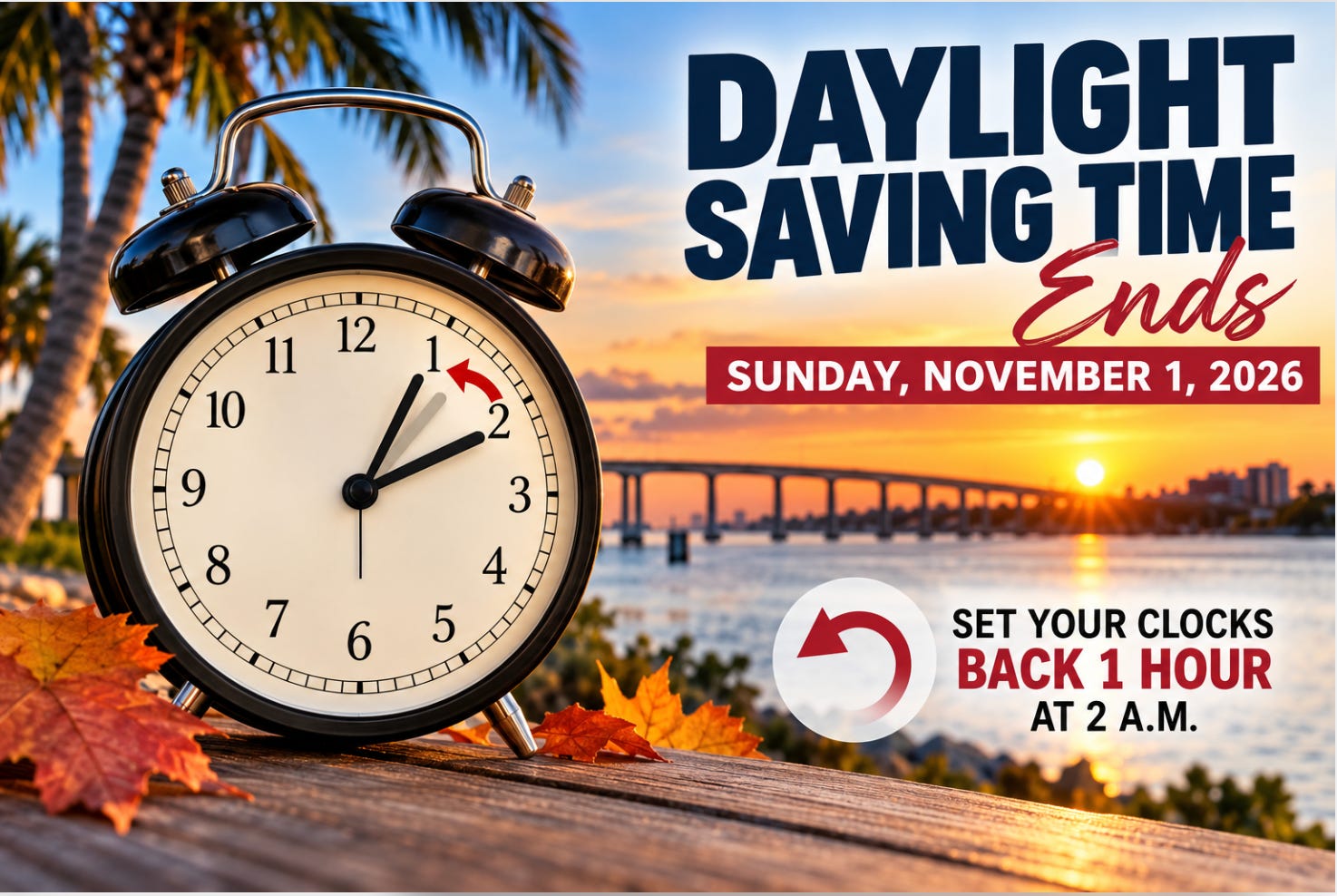
Residents across Manatee County will turn their clocks back one hour on Sunday, November 1, 2026, as daylight saving time comes to an end. The annual change will bring earlier sunrises, earlier sunsets, and an extra hour overnight as Florida returns to Eastern Standard Time.
At 2 a.m. Sunday, clocks will move backward to 1 a.m. While most smartphones, computers, and other connected devices will update automatically, residents should check clocks in vehicles, appliances, and other devices that may require manual adjustments.
The change will remain in effect until March 14, 2027, when daylight saving time begins again.
What the Time Change Means for Manatee County
For residents of Bradenton, Palmetto, Lakewood Ranch, Parrish, Anna Maria Island, and surrounding communities, the most noticeable difference will be the shift in daylight hours.
Morning commuters and students waiting at bus stops will experience earlier daylight, while residents traveling home from work, attending evening activities, or enjoying outdoor recreation will notice darkness arriving approximately one hour earlier.
The change does not create or eliminate daylight. Instead, it shifts the amount of available sunlight relative to the clock. As winter approaches, the natural shortening of daylight hours will also continue.
For Manatee County’s coastal communities, earlier sunsets may affect the timing of beach visits, boating excursions, waterfront dining, and other outdoor activities. Residents planning evening activities should account for the earlier arrival of darkness.
Increased Attention to Pedestrian and Bicycle Safety
The return to standard time also creates potential safety concerns for motorists, pedestrians, and bicyclists.
As sunset occurs earlier, more afternoon and evening travel takes place after dark. This can be particularly important along busy Manatee County roadways, near schools, in residential neighborhoods, and in areas where residents walk or bicycle for transportation or recreation.
Research published by the Insurance Institute for Highway Safety found that fatal crashes involving pedestrians and bicyclists increased by approximately 13% during the five weeks following the fall time change, compared with the five weeks before it, in a national study examining crashes from 2010 through 2019.
The findings highlight the importance of visibility during the evening hours. Motorists should remain alert for pedestrians and cyclists, particularly at intersections and crosswalks. Those walking or bicycling after sunset can improve their visibility by wearing reflective clothing and using appropriate lights.
How Changing the Clocks Affects Sleep and Health
Although the fall time change provides an additional hour overnight, adjustments to sleep schedules can still affect the body’s internal clock.
According to the Centers for Disease Control and Prevention, changes in daylight exposure and sleep schedules can influence circadian rhythms, which regulate sleep and wakefulness.
Children, older adults, and individuals with established daily routines may need time to adjust to the new schedule.
Health experts recommend maintaining consistent sleep and wake times, getting natural light in the morning, and allowing sufficient time for rest. Adults generally need at least seven hours of sleep each night.
For Manatee County families, maintaining regular bedtime routines can help children adjust before returning to school on Monday, November 2.
Time Change Provides Reminder to Check Smoke Alarms
The seasonal clock adjustment also provides an opportunity for residents to review household safety measures.
The U.S. Consumer Product Safety Commission encourages families to test smoke and carbon monoxide alarms, replace batteries when necessary, and review home fire escape plans.
Smoke alarms should be installed inside bedrooms, outside sleeping areas, and on every level of the home. Carbon monoxide alarms should be installed on every level and outside sleeping areas.
Residents should replace batteries according to manufacturer recommendations, except in alarms equipped with sealed, long-life batteries. Smoke alarms generally should be replaced after 10 years.
Families are also encouraged to practice fire escape plans and ensure everyone knows how to exit the home safely during an emergency.
Why Does Florida Still Change Its Clocks?
Florida lawmakers have supported eliminating the twice-yearly clock changes for several years.
In 2018, Florida enacted its Sunshine Protection Act, expressing the Legislature’s intention to establish permanent daylight saving time throughout the state. However, the law cannot take effect without authorization from Congress.
Under current federal law, states may choose to remain on standard time throughout the year, but they cannot independently adopt permanent daylight saving time.
The issue remains under consideration in Washington. The U.S. House of Representatives passed the Sunshine Protection Act of 2025 in July 2026, and the legislation was referred to the Senate Committee on Commerce, Science, and Transportation. As of October 27, the measure has not become law.
Supporters of permanent daylight saving time favor additional evening sunlight for recreation, shopping, and other activities. However, sleep researchers and medical organizations have raised concerns about maintaining later clock times year-round, particularly because of the effects of darker winter mornings on the body’s natural sleep cycle.
For now, Manatee County residents will continue observing the federally established schedule.
Earlier Sunsets Begin This Weekend
The approaching time change will be especially noticeable along Manatee County’s Gulf Coast.
In Bradenton, sunset on Saturday, October 31, is expected at approximately 6:47 p.m. Following the clock change, sunset on Sunday, November 1, will occur around 5:46 p.m. Sunrise will shift from approximately 7:40 a.m. Saturday to 6:40 a.m. Sunday.
The earlier sunsets will continue into late November as the region approaches the shortest days of the year.
Residents are encouraged to prepare for the transition by checking household clocks, maintaining consistent sleep routines, reviewing home safety equipment, and remaining attentive to changing daylight conditions.
Daylight saving time officially ends at 2 a.m. Sunday, November 1, 2026. Residents should set clocks back one hour before going to bed Saturday night.
Sources include: National Institute of Standards and Technology, U.S. Department of Transportation, Florida Legislature, Congress, Centers for Disease Control and Prevention, Consumer Product Safety Commission, and Insurance Institute for Highway Safety.